Dealer Log In
 1.800.537.1603
Choosing a floor mat for an office entrance is usually pretty straightforward. Choosing one for a production floor, maintenance area, commercial kitchen, loading zone, or electrical workstation requires a closer look at what the product will face every day.
Moisture is only one concern. Industrial floor mats may be exposed to oil, grease, chemicals, dropped tools, heavy foot traffic, rolling equipment, and repeated cleaning. Employees may also stand on them for most of a shift. A mat that performs well in one area can wear out quickly or create new problems when installed in another.
The right selection starts with the work environment, not the product catalog. By documenting the hazards, workflow, and maintenance requirements of each area, facility teams can narrow their options and choose matting that fits the actual application.
Start With the Conditions Around the Mat
“Harsh industrial environment” can describe several very different situations. A dry assembly station does not need the same construction as a washdown area. A mat near machining equipment may encounter substances that never appear at a warehouse packing station.
Before comparing industrial floor mats, answer a few practical questions:
- Is the floor normally dry, occasionally wet, or continuously exposed to fluids?
- Will the mat come into contact with oil, grease, cleaning agents, or other chemicals?
- Do employees stand in one position or move along a work area?
- Will carts or other wheeled equipment cross the mat?
- Are electrical insulation or static-control properties required?
- How will the mat be cleaned?
A single facility may need several matting products. The goal is not to find one mat that works everywhere. It is to match each product to the conditions found in its specific location.
Match Industrial Floor Mats to the Primary Hazard
Once the environment has been evaluated, identify the main reason matting is needed. Comfort may be the priority at one workstation, while drainage or chemical resistance may be more important elsewhere.
Dry Workstations and Standing Areas
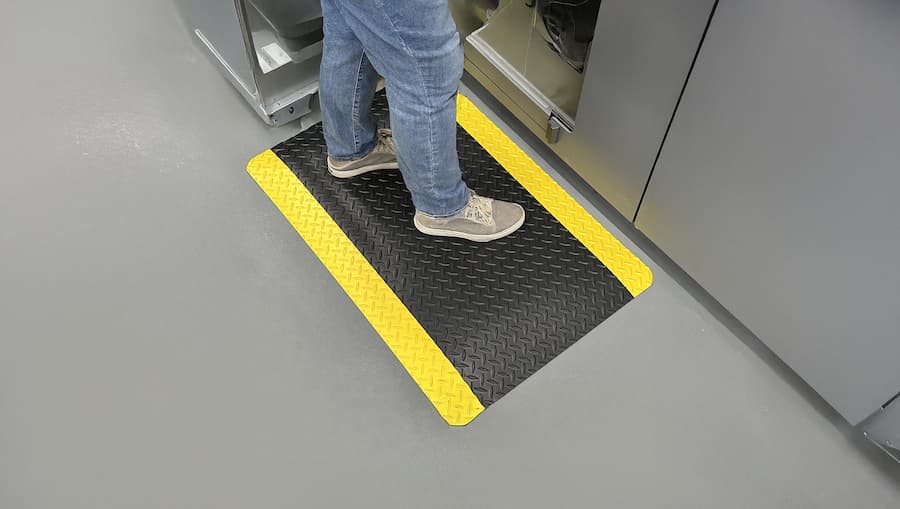
Employees who spend long periods standing on hard floors may benefit from anti-fatigue matting. These products provide a cushioned surface that can make standing workstations more comfortable while also supporting traction.
More cushioning is not automatically better. A mat that is too soft may feel unstable, interfere with movement, or compress under constant use. Thickness should also be considered around doors, equipment, carts, and other floor transitions.
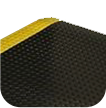
Surface construction is another factor. Diamond patterns, ribbed surfaces, and textured finishes can provide different levels of traction and cleanability. Beveled edges may help create a smoother transition between the mat and surrounding floor.
Wet, Oily, or Greasy Areas
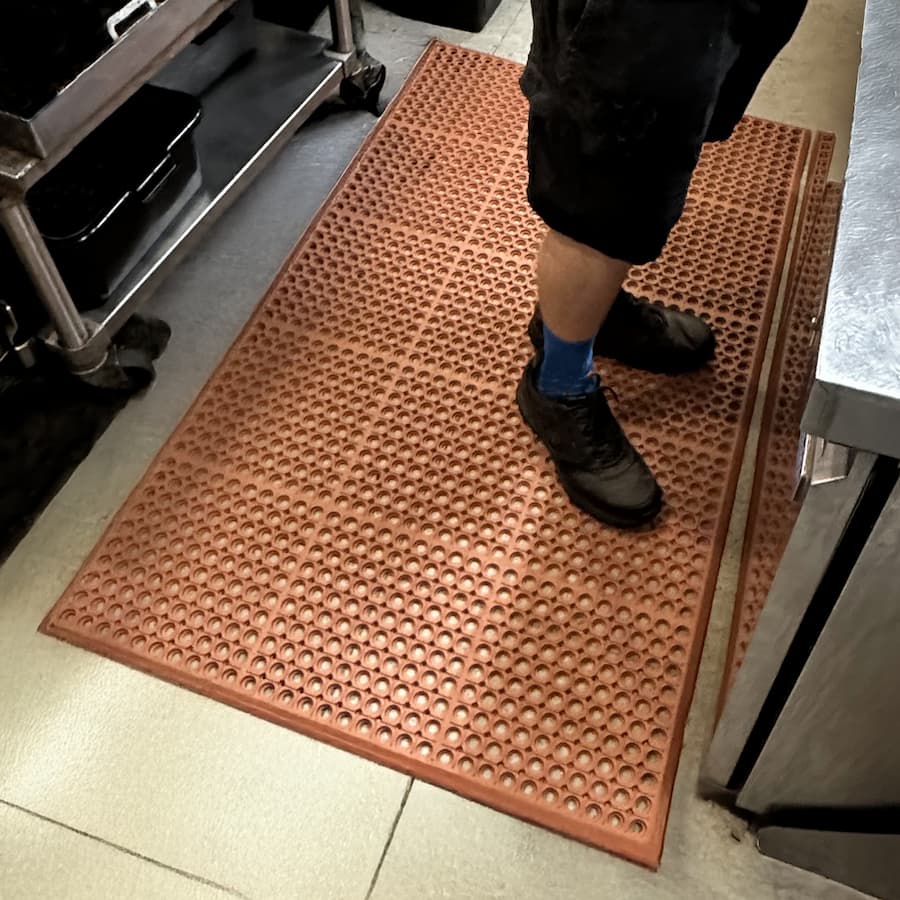
A solid anti-fatigue mat may not be suitable where water, oil, or other fluids regularly collect. In these environments, the mat needs to provide traction while allowing liquids to move away from the walking surface.
Open-grid construction and drainage holes can help keep employees above standing moisture. Raised undersides may also create space for liquid to flow beneath the mat instead of pooling around a worker’s shoes.
Material selection becomes especially important when oil or grease is present. General-purpose rubber may work in some wet areas, while grease-resistant rubber, nitrile, or a specially formulated vinyl may be needed in more demanding applications.
Chemical-Exposure Areas
A product described as “heavy duty” is not necessarily resistant to every substance used in an industrial facility. Oils, solvents, acids, cleaning products, and food-processing compounds can affect mat materials differently.
Before choosing chemical-resistant industrial floor mats, identify the substances the mat may contact. Include occasional spills as well as chemicals used during routine sanitation. The length and frequency of exposure can matter just as much as the substance itself.
Electrical and Static-Sensitive Areas
Some work areas need more than a standard comfort mat. If employees work near electrical equipment or handle sensitive electronics, the mat must be designed for that specific risk.
Static-control mats help prevent small electrical charges from building up and damaging electronic parts. Some of these mats use a grounding cord to safely carry the charge away.
Insulating switchboard mats serve a different purpose. They are placed near electrical panels or equipment to help protect workers from electrical current. These mats must match the voltage level and safety requirements of the area, so a standard anti-fatigue mat should never be used as a substitute.
Compare the Material and Surface Construction
Material names provide a useful starting point, but they do not tell the entire story. Rubber, nitrile, PVC, vinyl, and polyurethane can each be formulated for different levels of resilience or exposure resistance.
- Rubber products are commonly used for traction and demanding wet-area applications.
- Nitrile rubber can provide stronger resistance in environments involving oils or grease.
- PVC and vinyl are available in solid, cushioned, ribbed, and open-grid formats, making them suitable for a broad range of uses.
Surface design also affects performance. Open surfaces support drainage, while raised patterns can improve traction. Smooth or lightly textured surfaces may be easier to clean in dry areas. The backing, thickness, and edge design determine how securely the mat sits and how easily employees or equipment can cross it.
The best comparison focuses on the complete construction rather than choosing by material alone.
Cleaning and Inspection
Industrial floor mats do not remain effective without regular maintenance. Dirt can fill surface patterns, drainage openings can become clogged, and residue can make a previously slip-resistant surface less dependable.
Before purchasing, determine how the mat will be cleaned. Some products can be swept or vacuumed. Others may need to be rolled up, scrubbed, or hosed down. Large or heavy mats may require more labor to move, which can affect whether the maintenance plan is realistic.
Inspections should look for worn surfaces, damaged connectors, curling edges, movement, and areas that no longer drain correctly. Cleaning and inspection frequency should increase in locations exposed to heavy debris or frequent spills.
Make the Right Investment the First Time
Choosing the right mat from the start means looking beyond basic size and surface style. The product needs to fit the hazards, traffic patterns, cleaning process, and daily demands of the area where it will be used.
A mat selected for the wrong conditions may wear down quickly, shift during use, or fail to provide the drainage or resistance the space requires. Taking time to evaluate the application upfront helps ensure the mat supports worker comfort, protects the floor, and performs as expected over time.
Need help comparing options? Contact Durable or locate a Durable Dealer to discuss your facility conditions and find matting suited to the application.